Tuesday, 16 February 2010

The Princess and the Coelacanth: Back to the Future


Sitting in front of Avatar (or, even, sitting ‘within’ it), goggles strapped on, the IMAX screen yawning open 50 feet away like the Stargate, was quite a memorable end to the cinematic decade. After 10 years of Hollywood becoming a grim sequel factory, here was an industrially-produced film with no pre-release recognition, and an original storyline (pace Poul Anderson). Its subsequent rise to the Most Successful Film Of All Time seemed inevitable, but justified: the film was doing something far beyond the norm.


The most intriguing thing, however, was the manner in which it delivered this ‘new’ experience. The audience was deliberately allied with Corporal Jake Sully (as we sit immobile in our cinema seats, he in his wheelchair), trapped in a grey almost-2D world. But then, he slipped into his headset-Avatar-wire-getup, just as we'd slipped into our goggles, and we escaped away with him into the gloriously eye-popping dreamworld of PANDORA, a 3D paradise. No other film has so self-consciously dramatized the transition between two cinematic media since (at least) 1939, when Victor Fleming swept Dorothy out of monochromatic Kansas, and into the Technicolor land of Oz. Dorothy Gale and Jake Sully are two classic audience surrogates, holding our hands as we enter a new world.


This transition towards the ‘New World’ of cinema has been apparent for some time. And nowhere more so than in the North American animation industry: ever since the release of Toy Story in 1995, 3D CGI has been leading cartoon audiences away from cel-animated flops such as The Emperor’s New Groove, and Treasure Planet, and into endless franchises, such as the infamous Shrek. The gloomy situation was summed up by Guy Adams, in The Independent:

By 2006, Hollywood, the birthplace of Mickey Mouse, hadn't a single hand-drawn department left. Some of their former employees were simply sacked; others retrained in the new-fangled computer technology. Thousands of creative careers hit the scrapheap. An entire art form seemed to be heading for extinction.”

John Musker tells Adams “they even decided to scrap the desks we'd worked on, and throw away the paper that we used to sketch”, at which his co-director Ron Clements points out that animation has always been a “craft passed on from generation to generation. [My] apprenticeship was under Frank Thomas, one of Walt's 'nine old men’. If we'd left things idle for too long, connections like that would have disappeared. I'm not sure we'd have ever got them back.” Clements, once apprenticed to the man behind the ‘pink elephants on parade’ in Dumbo, appears here stranded in a wilderness of scrap-paper, as Avatar, a 3D goliath, stomps onstage to conclude short process of extinction, just as The Wizard of Oz once did for black-and-white.

Yet on Friday February 5th, a new Disney film was released in the UK. It is resolutely 2D, and has been created by the greats of lo-fi yesteryear (Musker and Clements, with their ‘sacked thousands’), painstakingly reinstated by John Lasseter, the former head of Pixar. This is an act of humility, but also of historical reverence: The Princess and the Frog is set at the exact time that Walt Disney founded his first animation studio: on October 16th 1923. The film is locked into a very deliberate historical age and place… not the ‘fairytale’ no-time of Snow White, but a segregated South, an uneasy world in which our African-American heroine is first glimpsed sitting at the back of a bus, with her mother.


Musker and Clements take advantage of this historical setting, the most precise of any Disney film to date, and range through the music and culture of the Jazz-Age South. Instead of the glib pop-culture references throughout Dreamworks’ Shrek and Shark Tale, we first meet Louis the Alligator as he plays the opening of his namesake Armstrong’s 1923 hit ‘Dippermouth Blues. These characters are moving through a New Orleans painted according to Tennessee Williams (with a character called ‘Big Daddy’ calling for his ‘Stella’, and an alligator named after Marlon Brando), huddled beneath a star named for Longfellow’s Cajun ‘Evangeline’ (the titular character in a poem dating from 1847). Running throughout, Randy Newman’s music is – at last – relevant, the biting satire and New Orleans detail of his solo work employed in a far more meaningful way than in Toy Story’s pleasantries (‘You’ve Got A Friend In Me’).

This precise and ambitious framework, ranging from Longfellow to Williams, through literature and music, underlines the directors’ awareness of cultural context, and emphasises the boldness of their choice of a segregated world (with its glimpses of undercover-drinking during prohibition) for the first African-American leading character in the ‘Disneyverse’ since 1942’s Song of the South. As Guy Adams notes: “away from the White House, America has rarely seen a more potent symbol of change in recent times than Tiana.” She is a princess of the future, a feminist, far more self-reliant and able than the prince: a heroine it is possible (for once) to believe in.

Perhaps as surprising as all of these up-to-date cultural/political signals, however, are the constant references by Musker/Clement to the history of their own ‘extinct’ art form, references that dominate the film from its opening sequence, in which the young Lottie’s shelf is seen to boast figurines of Disney’s ‘Cinderella’ and ‘Sleeping Beauty’. These scenes are set in the pre-WWI era (prior to Walt’s earliest dream of owning Laugh-O-Gram Studios), yet our heroine already has dolls relating to films released during the height of the Cold War.

The Princess and the Frog is, in fact, a painstakingly reconstructed work of prophecy, a vision of the entire legacy of the hand-animated film, set in the year that Disney was working on his first masterpiece, Steamboat Willie (glimpsed in the opening logo, newly designed by Lasseter). Just minutes into the film, with Lottie’s dolls, it is apparent that we are watching a work of careful anachronism, as deliberate (and as strange) as the use of Wagner’s Rheingold in Terrence Malick’s ‘New World’ of 1607, or of Ennio Morricone’s 1970s Rabbia E Tarantella in Quentin Tarantino’s WW2.

These references, as the two directors (trained by Walt’s ‘nine old men’) take stock and remember their almost-extinct art form, proliferate to a gradually overwhelming degree. In one viewing, the following references stood out:

Snow White and the Seven Dwarfs: adrum-solo’ prompted by trying to hit animal with sticks (a fly in SW, a frog in PF)
Pinocchio: wishing on a star
Dumbo: pink elephants dancing (lit green and pink) evoked during the frogs' underwater dance
Cinderella and Sleeping Beauty: dolls on Charlotte’s shelf
Peter Pan: Dr. Facilier’s shadow, with a mind of its own
Lady and the Tramp: tongues as spaghetti, pulling them to kiss

The Jungle Book: Fireflies light up Louis as Baloo with pineapple on head and grass skirt, and his song evokes King Louis’s (‘I Wanna be like you’)

Robin Hood: Hiss the snake appears as Mama Odie’s snake
The Rescuers: musical aligators
Basil The Great Mouse Detective: Dr. David Q Dawson (‘Watson’) as Lawrence, Naveen’s servant
The Lion King: idea that stars are fireflies (originally Timon’s idea)
Pocahontas: raccoon at funeral

Having a quick look through the various reviews posted online so far, two other (even more obscure) references crop up:

The Adventures of Ichabod and Mr. Toad: Mr. Toad’s horse, Cyril Proudbottom, is glimpsed outside a shop
Aladdin: a woman is seen cleaning the distinctive Magic Carpet in the street

And the most obscure of all:

Firefly Five Plus Lou: Louis’s band is a reference to the 1950s jazz band ‘Firehouse Five Plus Two’, in which the animator Frank Thomas (Clements’s original mentor) played piano

These references span three-quarters of a century of animated films, and creep into almost every sequence. It seems, given the sheer number that can be glimpsed on just one viewing, that Musker/Clement have almost certainly embedded references here to every film in the canon, as our off-screen Walt ‘prophesies’ his own future, in 1923.

In doing all of this, the film manages to provide a vision of a thrilling artistic future, through an exhaustive understanding of a cultural (and national) past. The filmmakers rely on a cinematic tradition that began with Walt Disney’s five films prior to America’s entry into WW2 – Snow White, Pinocchio, Fantasia, Dumbo and Bambi – a 'run of five' unmatched by any other filmmaker in history (with the possible exception of Kubrick, over the much longer period of 1964-80: Dr. Strangelove, 2001: A Space Odyssey, A Clockwork Orange, Barry Lyndon and The Shining).

If Musker/Clements’s deliberate nods to these classic Disney works, combined with the ingenious ‘prophetic’ framework of the film, does indeed signal a Renaissance, then the once-sacked animators need not be unduly worried by the rise of Avatar, or by the sad death of Roy E. Disney (only weeks before the film was released). Indeed, anyone who'd given up on the 'extinct' medium by 1996 (a year after Toy Story), would have missed the greatest Disney film since Pinocchio – the dark masterpiece that was The Hunchback of Notre Dame. Especially in its formidable musical sequences, The Princess and the Frog offers us more glimpses of this delight in painterly animation, of image-by-image invention and originality completely lacking from the action sequences that define a much lesser film, such as Up. Perhaps these images, and the deliberate historical focus of the film, hint that we can look forward to something very special, soon: an artistic Coelacanth, lurking in the shadows...

‘Cos remember, just two years after The Wizard of Oz announced the end of black-and-white cinema, Orson Welles released Citizen Kane.


Friday, 13 November 2009

Top 10 Films of the Decade


10) The Descent (2005)


In a now-infamous photograph, appearing on front pages throughout the world after 7/7, a stricken London bus showed a huge poster for The Descent on its side: an actress screaming in a tunnel, beneath a horribly ironic quotation: "Outright Terror... Bold and Brilliant." This final, totally unexpected image epitomized the horror that had gripped the decade, and which lurks behind the infernal visions of this film. Neil Marshall’s masterpiece takes a faintly crude metaphor (cave = female), and delivers from it a weird, miniature study of grief, and claustrophobia: Conrad's Heart of Darkness re-written in the stylish shadow of the Blair Witch. The hive of prehistoric ‘humans’ form a kind of mass manifestation of the poor Sarah’s blues (a final shot, revealing the inner dimension of the horror, was cut from the American edit). We pass through a vast psychological landscape, crossing a river of blood (echoing the climax of Apocalypse Now)... And only at the very end, if at all, do we realise that Sarah has gone on to kill five of these ‘beasts’; the number of human companions with which she originally entered the Appalachians.

9) Werckmeister Harmonies (2000)


The first great film of the decade, Béla Tarr’s follow up to the 7-hour Satantango is a short(er) study of music, order, and repression. At 2 ½ hours, the film only contains 39 shots, each averaging about four minutes in length, an anti-MTV stance that inaugurated a brand new style. This quiet revolution would inspire Gus Van Sant’s work throughout the decade (particularly his ‘Death Trilogy’), but Tarr’s films are quite unique. This is the greatest film ever to feature more than one 5-minute shot of a man staring into the eye of a whale carcass.

8) The Passion of the Christ (2004)


Along with the controversy merited by some of Gibson's idiotic subsequent antics, it is important to recognise that this was, and is (by far) the highest-grossing Art-Film ever made. With dialogue kept entirely in Aramaic and Latin, it's a basically plotless structure, and shot (with the aid of Terrence Malick) in the grand and doomy style of Caravaggio, filled to the seams with gold, black, and (of course) red. Since giving up acting in 2002, Gibson has – against all odds – emerged as quite a singular director. Surpassing his earlier Braveheart, his recent work has consistently explored more neglected areas of history, culminating with the rather improbable subject of his next film, The Professor and the Madman: a study of the origins of the Oxford English Dictionary...

7) Rachel Getting Married (2008)


This list naturally excludes the work of David Simon, the great social realist of the decade, who re-invented the war genre (with Generation Kill), and the depiction of an entire city (with The Wire). Only one film took an approach that was comparably original, and that was Jonathan Demme’s first new picture (excluding documentaries, and 2 remakes) in over a decade. Making Vinterberg’s Festen look like a whodunit, the film explored ensemble characters and depicted a single everyday event with an entirely new style, like a sort of post-9/11 Altman. As Roger Ebert remarked, the entire work seemed like “the theme music for an evolving new age.”

6) Drag Me To Hell (2009)


Goethe’s Faust for the 21st century, updated to address the Depression, this hyper-intense depiction of the damnation of a bank worker surpasses even Raimi’s previous masterpieces The Evil Dead (1981) and Evil Dead II: Dead By Dawn (1987). Employing a kind of Rabelaisean comic-horror, the film explores the boundary between terror and hilarity (namely, hysteria), with insane Ren-and-Stimpy-esque violence: the arm-swallowing-anvil-dropping-eyes-popping scene is a glorious technicolour classic. Filled with unexpected contexts and references, from Keats’s Lamia to the aesthetic of Jacobean Tragedy (the image of the bearded man dancing on the flaming table), it is surely the Great Horror Film of the decade.

5) Irreversible (2002)


If Kubrick’s final film ended with a peculiar kind of optimism (“let’s fuck”), and if this continued into the posthumous A.I. (“Maybe the one day will be like that one day inside the amphibicopter…”), then this film, by his greatest apostle – Gaspar Noe – is much more ambivalent. A despairing tale of entropy (its epigraph is ‘Les Temps Detruit Tout’, or ‘Time destroys all things’), Irreversible shows an idyllic couple reduced to a violent state approaching hell. What is so unique, however, is that this anti-Death-Wish chooses to invert the narrative, showing innocence growing out of despair, and life out of death. The title and epigraph cast this reversal in an ironic light, but the film remains both a depiction of suffering and of a flickering symmetrical universe beyond.

4) United 93 (2006)


The only film so far to tackle head-on the events with which this decade began (9/11 occurred just eight weeks after A.I. was released). Filled with sympathy for the victims, and with authenticity (the air-traffic controllers appearing as themselves), Greengrass also reveals an urgent desire to understand the perpetrators. From the beautiful opening shots, as a muezzin sings the adhān over a sunrise, to the subtle hints of cultural alienation that run throughout (such as the glimpses of adverts for beauty products, lining the airport walls) the film leads up to a totally unforgettable final image – especially effective if witnessed in the cinema – in which the entire room seems to collapse into the earth.

3) Inglourious Basterds (2009)


It took Pynchon just two decades to come up with his chaotic, shocking and sophisticated response to WW2, the horrifying ‘Dr Hilarius’ in 1966. At last, on the 70th anniversary of the start of the war, Tarantino has achieved the same in cinema. His dark masterpiece, the film offers a fitting end to the decade: a gigantic Gravity’s Rainbow filled with glorious writing and imagery. The final scene, an apocalyptic deconstruction of propaganda, was shot on Goebbels’s own sound stage.

2) A.I. (2001)


The best film Kubrick never made, A.I. also remains the single most probing examination of the ethics of modern technology. By turns cold, frightening, intellectual and touching, it is, among many other things, a strange kind of adult ‘Pinocchio’ for the digital age. The images are haunting, and the dialogue often sounds like a dream, employing music, and half-rhyme (“Is Blue Fairy Mecha, Orga, man or woman?”; “Hey Joe, What do you know?”; “Come away O human child, To the waters and the wild”; “Cirrus, Socrates, particle, decibel, hurricane, dolphin, tulip”; “All roads lead to Rouge”; “Sir, would you be so kind and shut down my pain receivers?”; “Many a mecha has gone to the end of the world, son, never to come back. That is why they call the end of the world 'MAN-hattan'”). A poetic 'defence of HAL', 40 years on, Kubrick's swansong is surreal, modernist, and deeply weird.

1) The New World (2005)


With this masterpiece, Malick invented a new way for cinema to portray nature, as well as offering an in-depth examination of the origin myths of the 21st century’s main super-power. A timely political work by a key American artist, it is also a timeless and philosophically ambitious film, overflowing with literary and musical references to centuries of European tradition. The most artistic piece of cinema since Kubrick’s 2001, it was conceived during the Vietnam war, and finally put into production during the earlier work’s prophetic date – as America experienced a second national tragedy. Its closing image of a falling seed, a haunting symbol of simultaneous tragedy and rebirth, triumphant re-creates the very last lines of Rilke's Duino Elegies, written over 80 years earlier:

Und wir, die an steigendes Glück
denken, empfänden die Rührung,
die uns beinah bestürzt,
wenn ein Glückliches fällt.

(And we, who have always thought of happiness as rising, would feel an emotion that almost overwhelms us whenever a happy thing falls.)

A requiem for a vanished era, the film is also, in the end, a visionary depiction of the precise moment at which a new one emerges.

Saturday, 31 October 2009

Back Into the Woods: The Blair Witch Project 10 Years On


Today, Halloween 2009, marks the tenth anniversary of the original cinematic release of The Blair Witch Project. With that fresh and altered perspective, the film seems, inevitably, much less ‘new’. All those elements that received press attention at the time – its independently financed, lo-fi, and unscripted qualities – now seem less of a threat to the studio system than they did in 1999, when the film was chomping at the heels of The Phantom Menace.

Indeed, with the notable exception of its exploitation of the internet as a means of promotion, none of the film's innovations have seriously entered into the mainstream in the following decade. Here, in box-office order, are the 2000s’ 10 top-grossers:

Batman 6 (The Dark Knight)
Shrek 2
Pirates of Caribbean 2
Spider-Man
Transformers 2
Star Wars Episode 3
Lord of the Rings 3
Spider-Man 2
The Passion of the Christ
Lord of the Rings 2

Every single one (with the very notable exception of The Passion) is part of a sequel franchise, every one the product of a major studio, all hi-fi, and ‘properly’ scripted.

But, as the years pass, the film seems less portentous of some future 'Collapse of the Industry', and more representative of the more distant past. Specifically, it hints back at the tangled history of America, and the underlying land itself.

The fictional mythology behind the film, meticulously developed, but only hinted at on screen (another example of Haxan Films’ multimedia innovation) stretches all the way back to the earliest pre-Revolutionary years of the nation. The timeline, given in books such as The Blair Witch Dossier, runs as follows:

1620 – Nathan and Virginia Blair set up an outpost in Colonial America
1776 – The Declaration of Independence signed
1785 – An old woman, Elly Kedward, accused of witchcraft, for ‘drawing blood’ from children in the town of Blair
1786 – Half of the town's children vanish, and the locals flee the town
1809 – A book published detailing the events
1824 – Burkittsville founded on the site of Blair
1825 – Eileen Treacle (10 years old) dragged into Tappy East Creek by a woman's hand. The creek is clogged with oily bundles of sticks and the water becomes unpotable.
1861-5 – The Civil War
1886 – Robin Weaver (8 years old) disappears. The search party are found tied together and disemboweled at Coffin Rock.
1941 – Rustin Parr emerges into the village, saying that he is “finally finished.” Admits killing 7 children in his house, claiming the voice of an old woman in his head commanded him to do it. His house is burnt to the ground, and he is hanged. At the end of the year, America enters WWII.
1994 – Three students enter the Black Hills surrounding Burkittsville, to shoot a documentary about the Blair Witch
1995 – A backpack full of film equipment is discovered in the forest.
1997 – The case is declared inactive, and unsolved. The Donohue family send the 19 hours of footage to Haxan Films, asking them to assemble a rough cut, to raise awareness of the events.
1999The Blair Witch Project is released.

These details, all elaborated with old manuscripts, woodcuts and photographs, are very carefully assembled. Names, while all realistic, are deliberately chosen to evoke past figures: the possessed murderer, Rustin Parr, recalls the infamous figure whose occult practices led indirectly to the collapse of Tsarist Russia. And aren’t his last words, anticipating those of Daniel Plainview in There Will Be Blood, a grim re-utterance of Christ’s “Consummatum Est”? The witch, Elly Kedward, on the other hand, is a precise anagram for Edward Kelly (1555-97), the Renaissance alchemist who claimed to communicate with hordes of angels using his own ‘Enochian’ alphabet.

Using these signposts, and others (such as situating the story in 1994, the last days of grunge, rather than in the more immediate past), the story has the uncanny sense of a half-recollected truth, an occult thread beneath the more familiar history of the past 300 years. We are glimpsing a parallel history of America: what lies beneath.

The fundamental structure of the film itself, advancing from these outside elements, is the erosion of human identity in the face of Nature. The film works, deliberately, as a modern piece of dark Romanticism, that typically American genre, recalling Melville at his most despairing, or the theological/existential terrors of Lovecraft. If Heather’s to-camera monologue suggests the Antarctic death of Robert Scott (as Roger Ebert hinted), the two dropped cameras at the end enact a shared version of the ‘dropped pen’ at the end of a piece of Gothic fiction, by Edgar Allen Poe, or the like.

The film gradually loses its three human faces in a mass of trees, water, leaves, and light. As much as Tarkovsky, Malick, Kiarostami, or Tarr, the directors are experimenting with slowing our attention to the rhythms of nature (a simple flicker of day - night - day – night), and encouraging our eyes away from the human and towards the other ‘living things’ constantly before our eyes. Like The Thin Red Line, in which our attention is pulled from a battlefield to a chick in a tree, or a curling frond of sensitive mimosa, we are gradually seeing, more and more, the sunlight winking through the trees, and the patterns and differences between the thousands of plants in the forest. The humans, it seems, are already dead.

Perhaps the major legacy of the film (in the subsequent decade, at least) has not been a reinvention of the language of the blockbuster, but of the art house. Gus Van Sant's “Death Trilogy” (Gerry 2002, Elephant 2003, Last Days 2005) marked the director's return from the mainstream (his previous three films were Good Will Hunting, Psycho and Finding Forrester) to the independent fringe. The form he used, in making this change, was deeply reminiscent of Sanchez/Myrick’s earlier film: his trilogy showed doomed Generation-X youngsters slowly surrendered to nature (Last Days), the elements (Gerry), and each other (Elephant).

Moving even beyond its subject matter, Van Sant's trilogy seemed to draw its fluid (ab)use of Time and Space from The Blair Witch Project. In all three films, scenes unfolded in an unnerving un-chronological manner, spatially wandering, as if editing circles around a moment of tragedy. In The Blair Witch Project, the characters are physically walking in extended circles – heading south all day, only to end back at the same river (much as the characters in Elephant are always drawn back to the moment of the massacre), like so many moths to bulbs. And, even while the space of The Blair Witch Project coils into itself, the filmmakers impossibly “lost in America” (a world that believes it has tamed its wildernesses beyond recognition, as Michael points out in a key scene), the same thing is happening, imperceptibly, with time itself. “It’s all around us.”

In the material surrounding the film, it is noted, disturbingly, that a search party was launched for the filmmakers after they had been in the forest for only four days (having “failed to return for classes”). Yet they wander, here, for eight days and seven nights, spiraling through the Black Hills, an area that is not, as they keep telling each other “that big”.

So, where are they? The abandoned house, into which they plunge in the film's indelible final moments, the horrible magnetic core of the horror, is the clue. It was, once, the house of the child-murderer Rustin Parr, but it no longer even existed in 1994. It had been burned down, the false newspaper reports on the website, in the TV documentary, and in the ‘Dossier’ book tell us, back in 1941. Furthermore, their film cans were actually found buried beneath the foundations; yet, as the fictional ‘Professor Mercer’ tells us, the “pilings for the house have been in the ground since before the Civil War…”

The house at the end of the film, then, which burnt down over half a century before they entered the woods, conceals their bags, impossibly, beneath 150 troubled years of American history. Like the blank hotel room at the end of Kubrick’s 2001: A Space Odyssey, this house is not the simple structure that it initially appeared: it is a passageway, a path back from the modern America with which the film began (a land of marshmallows, headphones and Gilligan’s Island) to an earlier America, or, even, a continent before Columbus. A stepladder, in the end, the film reaches into a land of infinite space, of un-glimpsed and incomprehensible threat, of mile after mile of trees, water, leaves, and light.

Wednesday, 14 October 2009

2009 National Book Award

This afternoon the 5 finalists for the 2009 National Book Award were announced.

Previous winners include behemoths like Pynchon's Gravity's Rainbow (1974) and Gaddis's JR (1976), and the tradition of honouring Epic-with-a-capital-E novels has continued ever since: the most recent winner was Peter Matthiessen's Shadow Country, an 800-page re-telling of the life and death of the Everglades outlaw Edgar J. Watson (1855-1810).

This year's nominees are, in that sense, a little surprising:

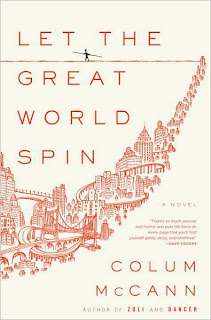
http://2.bp.blogspot.com/_6dDCuW-PQv8/Sj37q7xPzEI/AAAAAAAADFk/S6X3r8OopSc/s320/Let+The+Great+World+Spin.JPG
Let the Great World Spin, Colum McCann (link to video)
Irish/American b.1965, 368pp (An Irish family in 1970s New York, centred around the famous tightrope walk): 7th book, 5th novel. A previous book won the Rooney Prize and Irish Novel of the Year Award.

http://images-eu.amazon.com/images/P/0571237770.02.LZZZZZZZ.jpg
Far North, Marcel Theroux (link to opening pages)
British/American (Paul's son, Louis's older brother) b.1968, 304pp (Post-apocalyptic Siberia): 4th novel. Previous book won Somerset Maugham Award.

http://www.januarymagazine.com/fiction/ficimages/larkand.jpg
Lark and Termite, Jayne Anne Phillips (link to interview podcast)
b. 1952, 272pp (1950s family in West Virginia and Korean war): 9th book, 4th novel. Previous book won Massachusetts Book Award. Also received Guggenheim Fellowship, two National Endowments, and taught at Harvard.

http://static.guim.co.uk/sys-images/Books/Pix/pictures/2009/9/28/1254125979648/in-other-rooms-001.jpg
In Other Rooms, Other Wonders, Daniyal Mueenuddin (link to reading of final story)
Pakistani/American b.1963, 256pp (8 short stories set in Punjab): 1st book.

https://blogger.googleusercontent.com/img/b/R29vZ2xl/AVvXsEgMk3eU_kO1R3D09qktXC3A-nsseXVcRyhAdtbR98pvVY9p64biP0atUIKNQF7hQTG_9jjh6ikdKIECoJzoFfWMTwwlT-83yl3cR0mMydQlxRuaiDOZB94rGs2zVtCd88F1N1XaVy_Qb0s/s400/Campbell+cover-1.JPG
American Salvage, Bonnie Jo Campbell (link to first two stories)
b.1963?, 170pp (14 short stories about Michigan poverty): 4th book (incl. 1 novel)

All 5 books are shorter than 400 pages, and 2 are collections of short stories... Perhaps the Award is changing its focus? (Or, perhaps it's just time to read these books.) Another interesting point to note: with the notable exception of Jayne Anne Philips, all 5 were born within a five-year span in the mid 1960s...

Oh, and 3 of the 5 authors would not call themselves 'American' at all.

Friday, 25 September 2009

Warped 1950s: Indiana Jones & the Kingdom of the Crystal Skull

The forgotten blockbuster...

16 months have passed, and still no follow-up film from Steven Spielberg. Rumours surface, telling of a Lincoln biopic here, a Harvey remake there, an Old Boy remake, a Tintin adaptation... None of which are scheduled for release in 2009, or even 2010. Even if one (or more) of these projects reaches the light of day in 2011, we still have the longest gap in the director's entire career so far – 6 unexpectedly fallow years (2005-2011), with only one lonely film, in the dead centre of an artistic wilderness.

In taking the time to re-assess the value of this strange and already quite neglected film, a good start can be made with the narrative of the original trilogy. Although it might seem obvious, it’s worth putting the chronology all together:

1935 -
Temple of Doom - India (Sankara Stones)
1936 -
Raiders of the Lost Ark - Egypt (Ark of the Covenant)
1938 -
Last Crusade - Venice / Germany / Turkey (Holy Grail)

(1944 - George Lucas born)
(1946 - Steven Spielberg born)

1957 -
Kingdom of the Crystal Skull - Nevada / Peru / Amazon (Crystal Skull)

The first thing that strikes us, looking at the dates, is that neither Steven Spielberg nor Geroge Lucas had been born by 1935-8, the period of the first 3 films. The imaginative world of the trilogy was modelled entirely on Republic and Universal ‘serial’ pictures (such as The Great Alaskan Mystery, featuring nazi spies and futuristic weapons). Two decades later, by 1957, Spielberg was 11, and Lucas 13. Inevitably, Kingdom of the Crystal Skull represents something slightly different.

The film not only takes place in an era that both filmmakers remember personally, but also (and crucially) one which boasts an entirely different array of films to draw on; instead of ‘serials’, we have the 50s melodrama and B-film – Spies, planes and nazis make way for aliens, saucers and Communists. Fear of the German war effort is traded for something more subterranean – propaganda, indoctrination, and mind-reading. (Stalin, of course, was genuinely interested in these techniques. Rather more troublingly, the release of the CIA "Family Jewels" to the National Security Archive, on June 26 2007 – just eight days after Spielberg began shooting the film – showed the extent to which Sidney Gottleib and MKULTRA had been operating such experiments within the USA.)

This is the morally ambiguous territory that Kingdom of the Crystal Skull inhabits. Trading away the pure cinematic fantasy of the 3 ‘Republic Serial’ pictures for a strange, hybrid 50s, Shia LaBeouf’s entrance (to take an early example) is snipped straight from The Wild One, 1953, a move as surreal and artificial as anything in Tarantino/Rodriguez’s Grindhouse:

In moments such as this, parody is blurred with serious comment, almost beyond recognition. The climax of the Nevada sequence, as Indiana Jones comes across a picket-fence town in the middle of the desert, with clotheslines fluttering, inhabited only by mannequins, blankly watching television, is a horror/comedy moment worthy of David Lynch. The faceless figures sitting in front of the TV, blind and inch-deep, awaiting the explosion of Oppenheimer’s weapon, are a savage allegory of the 1950s society in which the filmmakers came of age.

Remembering MKULTRA, the fact that this is an all-American bomb (‘I like Ike’), very nearly killing an archetypal American hero, adds to the blurred environment of the film. The clear-cut boundaries of WW2 have dissolved, and in the following scenes, Indiana Jones is needlessly persecuted by the FBI, losing his job, and (in a highly symbolic moment of comedy) he mistakes a pair of KGB agents for the FBI agents themselves. Instead of the defined atmosphere of the 30s ‘serial’, we have entered a world of total paranoia.

This ambiguity extends into the Peruvian sequences, with the absurd image of Marlon Brando (ie. ‘Mutt’) striding into a Catholic asylum, and being led to the tomb of a real-life conquistador, Francisco de Orellana, who disappeared in the Amazon in the 1550s. With this, we see the dark past of America (the conquistadors, a madness portrayed in Aguirre: der Zorn Gottes) linked with its cinematic self-representation (Brando). Cue the entry of the Crystal Skull itself – torn from the rotting shroud of Orellana, it presents us with a palimpsest combining the most mythical past, with a surreal 50s 'future' (or, from our perspective, a parallel past). This is not just the treasure of a Spanish conquistador. It has been found by The Wild One. It is a part of the 1950s, Area 51, and ancient alien travelers... Again, parody and seriousness blur.

With that, we set into the exploration of mind control, Stalin and (implicitly) MKULTRA. Irina Spalko insists that they will be able to ‘control us through dreams’ until we ‘become them’. As paranoid and feverish as the Invasion of the Body Snatchers (1956), we are offered a vision of a monstrous communist plot, deranged and Strangelovian. Dean Charles Stanforth – Jim Broadbent – has already made the point: Communists in our soup. But, of course, in this film (a film where a joke about 'not stepping into old-fashioned fridges' is extended to the surreal survival of an atom-bomb), the mind control is real. An old friend is already maddened by it. Like the plastic family sitting waiting for the bomb, it is funny and unnerving. No longer the Ark of the Covenant, or the Holy Grail – instead of the manipulation of religious material (the discarded opium of the masses), the film shows us the manipulation of minds... 'Propaganda, and the media'.

Ultimately, all these themes are plunged into the jungle. And, as ever, it is the towering Jungle of the Imagination, inhabited by giant ants (borrowed from Charlton Heston’s The Naked Jungle, 1954), triple waterfalls and quicksand. Monstrous tree-devouring un-eco trucks, bazookas and swordfights definitively lay to rest the pretensions of Pirates of the Caribbean, National Treasure or The Mummy. We arrive at the mossy temple, having climbed through a skull’s-eye waterfall, and with the ‘hatching’ of the guardians through the walls we re-enter (or so it seems) the world of the Republic serial, as first seen in Raiders of the Lost Ark. Our Milton-quoting heroes make it to the huge columns, and onto the gothic, receding spiral staircase. Here, underground, we at last see the Skull replaced. The power of the mind is unleashed, and the 50s parody emerges with a vengeance. If Grindhouse ends with a car-chase worthy of Vanishing Point (1971), Kingdom of the Crystal Skull signs off with a re-enactment of the C-57D landing on Altair IV, from Forbidden Planet (1956). And doesn’t the swirl of substance, combined with the retro philosophizing of John Hurt (“the space between spaces...”) momentarily evoke the hideous bulge of the atom bomb over Nevada with which we began?

From the moment the film begins, not with the familiar theme but with Elvis Presley’s 1956 B-side ‘Hound Dog’, it is clear that this work represents a departure from the 1930s territory of the original trilogy. But, for all its parodic oddness, it succeeds in using Spielberg/Lucas’s most enduring, archetypal American myth for a lasting examination of one of the darkest hours of America. The years in which they grew up.


C-57D landing on Altair IV’, from “Forbidden Planet” (1956)

Sunday, 6 September 2009

Aldo Raine and Aeneas (Basterds Post Three)

"Each and every man under my command owes me one-hundred Nazi scalps. And I want my scalps..."

Brad Pitt's fearsome and paradoxically lynch-burned redneck, Aldo Raine, is (as has been spotted elsewhere) a direct tribute to Aldo Ray (star of 50s war films including The Naked and the Dead and Battle Cry), pictured to the right.

As well as this amusing homage to an Italian-American star (or Eye-talian, as Aldo himself might say), the character is, also, persistently identified as 'Aldo the Apache': a violent but courageous resistance fighter who takes the scalps of his victims. The fusion of 2 such apparently contradictory cinematic icons (the Soldier and the Indian) demonstrates the hybrid nature of this self-professed "spaghetti Western, but with World War II iconography" (as Tarantino described his film to Dylan Callaghan).

In addition to this bravura stylistic and satirical experiment (linking the cowboys with the nazis, the director imagines a form of American-Outsider resistance to both, exercised through the cinematic image, and liberal scalp-taking), Tarantino also seems to be exploring his own sense of American identity: his father was Italian-American, whilst the (single) mother who raised him was half-Cherokee. The film is, at least in part, Tarantino's 'Song of Myself', and Aldo Raine shares his own familial roots.

It is striking then that such an American figure, the most complex national symbol in all of Tarantino's films, is deliberately placed in the chapters of a work so defiantly European. The majority of the film's dialogue is in subtitled French and German. The main roles are all otherwise performed by Europeans... We find no Tom Cruise mugging as Claus von Stauffenberg in this war.

It is perhaps this conflation that leads to the final scene of this epic spaghetti-western being lifted directly from the founding epic of European literature, The Aeneid, as the Eye-talian Apache carves "his masterpiece", and is transformed into the horribly unforgiving Aeneas.

Here are the closing lines to Virgil's poem, as disturbing and abrupt as Tarantino's:

(The Aeneid, Book 12, Lines 927-952, Trans. David West) -

The Rutilian rose with a groan which echoed round the whole mountain, and far and wide the forests sent back the sound of their voices. He lowered his eyes and stretched out his right hand to beg as a suppliant:
"I have brought this upon myself," he said, "and for myself I ask nothing. But if any thought of my unhappy father can touch you, I beg of you – and you too had such a father in Anchises – take pity on the old age of Daunus, and give me back to my people... You have defeated me, and the men of Ausonia have seen me defeated and stretching out my hands to you. Lavinia is yours. Do not carry your hatred any further."
There stood Aeneas, deadly in his armour, rolling his eyes, but he checked his hand, hesitating more and more as the words of Turnus began to move him, when suddenly his eyes caught the fatal belt of the boy Pallas, high on Turnus's shoulder with the glittering studs he knew so well. Turnus had wounded him and then killed him, and now he was wearing his belt on his shoulder as a battle honour taken from an enemy. Aeneas feasted his eyes on this reminder of his own wild grief, then, burning with mad passion and terrible in his wrath, he cried:
"Are you to escape me now? Wearing the belt stripped from the body of those I loved? By this wound which I now give you, it is Pallas who cuts you. It is Pallas who exacts the penalty in your guilty blood."
And blazing with rage, he plunged the steel full into his enemy's breast. The limbs of Turnus were dissolved in cold and his life left him with a groan, fleeing in anger down to the shades below.

Wednesday, 2 September 2009

Follow-up: Beethoven and the Basterds

The critical teacup-storm surrounding this film is getting interesting. The Independent this weekend had a front page article entitled "The Tragedy of Tarantino - How He Squandered The Chance To Become One Of The Greats"...

In the wake of this (entirely coincidentally), yesterday I read a book about Beethoven's Third Symphony. The parallels were perhaps latent already: an established artist, popular with the critical elite, suddenly taking on a much more serious, political, subject, on an unprecedented, epic scale (the 3rd symphony is all about Napoleon Bonaparte, and was almost an hour long: nearly three times as long as any previous symphony). Beethoven even has epic violence followed by a 'drinking scene' (the 3rd movement is based on a soldier's 'trinklied')! With the Morricone-arranged 'Für Elise' of the opening, and the Beethoven card saliva-ed to a forehead in the drinking scene, the figure of Ludwig van seems to be constantly in the background of the film.

But the parallels didn't really hit me til I read the critical responses of the time, quoted in the book. Here is the critic from Der Freymüthige, assessing the responses in August 1806, about 10 months after the premiere:

"Some of Beethoven's particular admirers assert that it is just this symphony which is his masterpiece, that this is the true style for high-class music, and that if it does not please now, it is because the public is not cultured enough, artistically, to grasp all these lofty beauties; after a few thousand years have passed it will not fail of its effect.

"Another faction denies that the work has any artistic value and professes to see in it an untamed striving for singularity which has quite failed. By means of strange modulations and violent transitions, by combining the most heterogeneous elements, as for instance when a pastoral in the largest style is ripped up by the basses by three horns, a certain undesirable originality is perhaps achieved, but genius should not proclaim itself in the unusual or the fantastic.

"The third party, a very small one, stands midway between the others - it admits that the symphony contains many beauties, but concedes that the connection is often disrupted entirely, and that the inordinate length of this longest, and perhaps most beautiful of all symphonies, wearies even the cognoscenti, and is unendurable to the mere music lover; it wishes that Herr van Beethoven would employ his acknowledgedly great talents in giving us works like his previous two symphonies, works which have placed him forever in the ranks of the foremost instrumental composers."

The parallel is incredible. This is a work now (200 years later) universally acknowledged as a (and by a number of critics THE) turning point in western music. A watershed work of art, by a major artist. But it was met with accusations of "strange modulations and violent transitions" and claims that he has unsuccessfully combined "the most heterogeneous elements". Or the faint Mark Kermodeish praise of admitting that "the symphony contains many beauties, but the connection is often disrupted entirely, and the inordinate length wearies even the cognoscenti". The final wish ("that Herr van Beethoven would employ his acknowledgedly great talents in giving us works like his previous two symphonies") is so similar to the Independent/Guardian desire for another Reservoir Fiction as to be quite uncanny.

It isn't hard to think of films that gathered universal approval, but which will never be discussed in a decade's time (let alone 'a few thousand years'): just think of Sideways, Pan's Labyrinth, Capote, Lost in Translation etc etc... I think that Inglourious Basterds is quite another thing all together. Maybe a true watershed work. At last, somebody is forcing the focus of cinema towards the American Epic literary form: a huge and cascading novel of a film.

Here, at least, is an attempt to take the film seriously on its own terms:

http://blogs.suntimes.com/scanners/2009/08/some_ways_to_watch_inglourious.html

If only more critics were making the effort. But, as seen in a review from 1806, perhaps they never did.