10. Eternal Darkness (2002, Denis Dyack)
The first Nintendo title to be rated ‘M for Mature’, Eternal Darkness marked a new phase in interactive horror. Taking his cue from the invasive methods of Sakaguchi’s Final Fantasy VII, Dyack represents the protaganist’s deteriorating sanity by interfering with their control pad, and limiting or inverting the desired action. As the narrative progresses, these peculiar ‘Sanity Effects’ become progressively further removed from the artificial world, and start to enter the ‘real’: the television channel might accidentally ‘change’, or the screen abruptly warn that the ‘controller has been unplugged’. Manipulating the real-life fears of the hardware user becomes increasingly unexpected, and distressing: most memorably in the sadistic moment photographed above. It is in bizarre instances such as this that Dyack’s experimental debut work truly earns its faintly camp, gothic subtitle: Sanity’s Requiem.
 9. Scribblenauts (2009, Jeremiah Slaczka)
Following on from his original but flawed debut, Drawn To Life (in which the DS user was expected to create the key graphics from scratch), Jeremiah Slaczka and his team at 5th Cell went in a new direction with their second title. If their debut was a fundamentally empty title, awaiting user input, Scribblenauts is a contrasting monument to designer excess: over a period of two years, the developers trawled through their dictionaries, loading over 10,000 items into the ‘Objectnaut’ engine. One of the most ambitious projects in digital history, the basis of the puzzles can be summed up by the slogan ‘Write Anything – Solve Everything’: the player is encouraged to write the most non-literal, creative solutions to the onscreen challenge. Your character needs to enter a tunnel on the other side of a river? Try summoning a Kraken, a helicopter, a shrink ray, and a pirate ship… A magnificent example of the near-infinities that can be contained in a well-designed toy.
8. Ōkami (2006, Hideki Kamiya) 
Of recent videogames, few have been as explicitly inspired by an artistic-movement as Hideki Kamiya’s Ōkami (indeed, only Mizuguchi’s Rez, with its huge debt to Wassily Kandinsky, comes close). An homage to classic Japanese watercolour painting, the cel-shaded 3D aesthetic was quite unique in 2006, and remains so (despite imitations) today. The art concept is also boldly incorporated into the interface, as key actions are performed by the using Zen calligraphy motions with the Wii controller, painting ideograms in the air. Kamiya stands out as one of the few genuine auteurs in modern design, heavily visually focused, but able to draw together an incredible range of elements into a warped whole. His bizarre genius was glimpsed again in his 2010 follow-up title, Bayonetta, which fused together folk music, Renaissance religious art, disco, European architecture, and a terrifying heroine to make Quentin Tarantino proud.
 7. God of War (2005, David Jaffe)
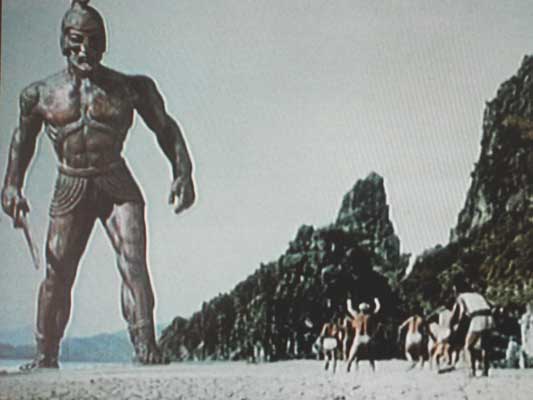
The most successful films based on Greek mythology – Jean Cocteau’s Orphée (1949), Disney’s Hercules (1997), or the Coens’ O Brother, Where Art Thou? (2000) – have always strayed from their source material, either resituating the familiar stories in different eras and continents, or undermining the grim seriousness of the original altogether. Only the various Ray Harryhausen epics have ever really come close to recasting the ancient mythical world as cinema, and the less said about the cringe-inducing Laurence Olivier-dominated Mount Olympus in Clash of the Titans (1981) the better. It comes as no small surprise, then, that the most compelling visual realization of this literary tradition came in 2005, with David Jaffe’s operatic God of War, a vast depiction of a battle between a Spartan and Ares, that has been followed up by two (even vaster) sequels. The world of Hades, the awesome scale of the gods, the physical enormity of the Titans, the terror of the gorgons: none of these things have ever been portrayed more vividly, or more accurately... Over the sublime trilogy, we encounter almost every character in Robert Graves’s The Greek Myths, from the famous (Theseus) to the obscure (Euryale), and every leering, terrifying monster. A huge, encyclopedic achievement, Jaffe’s trilogy shows the Homeric vision that has eluded a century of cinema.
6. Psychonauts (2005, Tim Schafer) 
Guided by an inspired concept – a sort of mental InnerSpace – Tim Schafer’s follow-up to Grim Fandango applies the subtle storytelling, unsettling environments, and brilliant comedy of his masterpiece to the apparently unrelated genre of the console platformer. Inspired by a one-off peyote experience, the psychedelic idea of exploring another character’s brain allows for a uniquely unhinged environment, as our hero ‘Razputin’ undergoes training at a US government lab (disguised as a children’s summer camp). Far more inventive than anything from the Pixar studio – let-alone Dreamworks – the work as a whole suggests that Schafer is among the leading animators of the decade (perhaps joined now, by Ron Gilbert, with DeathSpank). These two artists are using their cartoon-inspired design to tell some of the most ambitious and hilarious stories ever told in the medium.
 5. Resident Evil 4 (2005, Shinji Mikami)
The most purely terrifying experience in any interactive medium so far, Resident Evil 4 takes its place proudly alongside The Blair Witch Project, Evil Dead 2, The Texas Chainsaw Massacre and The Wicker Man as one of the great rural horror stories of the modern era. Departing from the familiar zombie-infested interiors of the first three titles in the series, Mikami’s masterpiece takes us to a remote Spanish village and its surroundings, in which a Cronenberg-style parasite known as Las Plagas (‘the plague’) has infected the majority of the farming inhabitants. Unlike traditional ‘shooter’ games, the 'survival horror' framework allows for only an extremely limited amount of health and ammunition, leading for a virtual reality world of unusual vulnerability, compared to Half-Life, or Doom. All of this, of course, makes the experience even more terrifying. If things all get too much, however, it is (thankfully) possible to follow in the steps of Sam Raimi, up the camp-level and grab the chainsaw. Groovy.
4. Portal (2007, Erik Wolpaw) 
With a stunningly original physics concept, a bleak-comic script by Tim Schafer’s Psychonauts co-writer Erik Wolpaw, and a masterfully gradual revelation of the Kubrick-inspired scenario underlying the entire simulation, Portal is a work of near total perfection. In any artform it is preciously rare for any combination to work so precisely: in few films, for example, is the balance of event and storytelling matched so skillfully, and no previous title challenges with the logical grace and aesthetic beauty of Valve’s masterpiece. Where Half-Life 2 was content to repeat the basic successes of its predecessor in high definition, Portal invented something entirely new. The designers explore the basic realities of ‘Space’ in a manner impossible in any other previous medium, matching and surpassing the non-Euclidean geometry explored in Echochrome, and the non-linear sense of time in 2008’s Braid. Ultimately, it is perhaps worth leaving the ‘last word’ on this 21st-century Escher-derived masterpiece to the brilliant Steve Meretzky. Watch his hilarious hymn to the world of Portal here.
 3. Heavy Rain (2010, David Cage)
Comparing the history of interactive storytelling with that of cinema, we soon hit the striking fact that the videogame medium is only 38 years old (considering 1972’s Pong as a starting point), the narrow sliver of time that separates the first films of the Lumière brothers from the original King Kong (1933). For such a young medium, the maturity of a work such as Heavy Rain is quite astonishing, showing the fully absorbed sense of quasi-ethical ‘choice’ that is central to the interactive experience, separating it from cinema as much as the spectacle of Kong was separate from the world of the theatre that spawned it. A work of unprecedented subtlety, David Cage’s interactive narrative follows four everyday characters with realistic motives: a father, a drug addict, a lonely woman, and a noirish detective. Some of the most impressive moments are those which draw the player into their most mundane moments, exploring the sense of melancholia surrounding an old amnesiac lady in a hospital ward, or the dizzying terror of losing a child in a crowded shopping mall. Through the sense of expanded time that the interactive medium enjoys over cinema, it is possible to let these moments linger, to leave a character in the company of another, to dwell in the wash of passing moments that shape their lives. Praised by artists as diverse as Terry Gilliam and Nicholas Roeg, David Cage’s tragic story is the first masterpiece of the new decade.
2. Shadow of the Colossus (2005, Fumito Ueda) 
Released in the winter of 2005, eight months after God of War, Fumito Ueda’s Shadow of the Colossus takes place on an unprecedentedly large canvas, even more epic than David Jaffe’s: a lone rider (with the Schubertian name of ‘Wander’) crosses a vast deserted mountainscape, seeking out, and murdering, a series of rather god-like titanic forms. There are no linking tasks at all, creating a deliberate sense of emptiness as we travel through the natural world, and the moral justification for the occasional acts of violence is never provided. This sense of doubt, combined with the awesome scale of the nemeses, creates the dawning suspicion that the series of ‘boss’ battles is a part of a deliberate ethical reflection on the role of goal-orientedness in modern interactive narratives, and on the connection between this and theological stories in general. The expanse of Nature, and sense of scale, links with the philosophical Sublime first explored by Edmund Burke in 1757, confirming the unexpected but crucial intellectual overlap between Fumito Ueda’s work and the cinema of his most comparable artist, Terrence Malick.
 1. Fallout 3 / New Vegas (2008, Todd Howard; 2010, Chris Avellone)
“There are all kinds of excursions and digressions that you can choose instead of the big story... the macro story. That really interests me as a storyteller, because I've always thought that one of the things that the gaming world permits as a narrative technique is to not tell the story from beginning to end – to tell stories sideways, to give alternative possibilities that the reader can, in a way, choose between."
These comments, made by one of our greatest living writers, Salman Rushdie, confirm the importance of videogames to any conception of storytelling in the 21st century. “Digression, alternative possibilities”, and “telling stories sideways” are techniques that have remained central to mainstream and experimental literature from Homer’s time to today, and the three categories apply to some of the most significant novels in history, including Don Quixote, Tristram Shandy, and Moby-Dick. It is in today's ‘interactive’ narratives that they are most richly explored, however, and in the past couple of years graphical worlds have at last expanded to accommodate this level of authorial ambition. It is perhaps unsurprising that the greatest 3D world of all has been designed and populated by the writers behind the largest (and arguably most literary) verbal worlds of the 1990s – namely Chris Avellone and his team, who created Planescape: Torment and the original two Fallout titles. The enormous dialogue trees and narrative digressions of these three classics were met, in 2008, with a virtual world to match. Fallout 3, a work of chilling retro-futurism, reveals the year 2277, as seen through the eyes of the first nuclear age – the 1950s. This inspired aesthetic juxtaposition has run throughout the series (and was famously copied by Ken Levine for BioShock), but reaches its apotheosis in the 3D world of this third title, as the unsettling future made possible in the test sites of Alamogordo and Nevada is brought into full digital life. The music, coming through the protagonist’s portable radio receiver, reveals the disturbing fixation the popular music of the era had with the apocalyptic weapon, as the Andrews Sisters look hopelessly at western civilization (“they have things like the atom bomb / I think I’ll stay where I om”), and The Ink Spots declare that they “don’t want to set the world on fire”… This use of unexpected cultural debris (one storyline concerns a Stradivarius violin and a Bach-obsessed widow of the Waste Land) elevates the apocalyptic narrative to the level of Margaret Atwood’s Oryx and Crake, whilst the underlying sense of humour hints at the pitch black comedy of Dr. Strangelove.
 The huge map of Washington D.C. was gradually expanded (through download) to include the remains of Pittsburgh, Alaska, and the Maryland swamps, and subsequently (in a 2010 disc) Las Vegas and the Mojave desert itself. This combined vision of apocalyptic America, seen through 1950s eyes, is haunting and unforgettable, a world with far more emphasis on dialogue than combat (as in Resident Evil, the protagonist is fundamentally more vulnerable than in a ‘shooter’), and with the staggering range of “excursions, digressions, and alternative possibilities” that so impressed Rushdie. The story encompasses the entire range of human experience, beginning with the character’s onscreen birth (viewed in the first-person), passing briefly through adolescence, and leading inevitably into the fallen world outside. An ongoing cycle of day and night (borrowed from Oblivion, Todd Howard’s previous work) combines with the limitless juxtapositions of the 3rd-person camera (unique to the player’s companions, attire, and location), making for arguably the most expansive literary world ever produced, in which it is possible to walk alone through a deserted casino at dawn wearing a 1950s space suit, or to swim through an empty battleship wearing a cowboy hat at night, or to explore a ruined village of atom-bomb worshippers accompanied by a loyal canine companion, sporting the tattered uniform of the Vault. These retro-futurist images feel uniquely personal to the individual experiencing them (and are), but also recall throughout the peculiar work of Thomas Pynchon, most of all Gravity’s Rainbow, rivaling even his imagination for outlandish, but weirdly profound, imagery. An inspired breed of science-fiction storytelling, infused with satire and politics, Fallout 3 surpasses anything similar in American culture since the peak of Rod Serling’s Twilight Zone, fifty years ago. Welcome to the future.